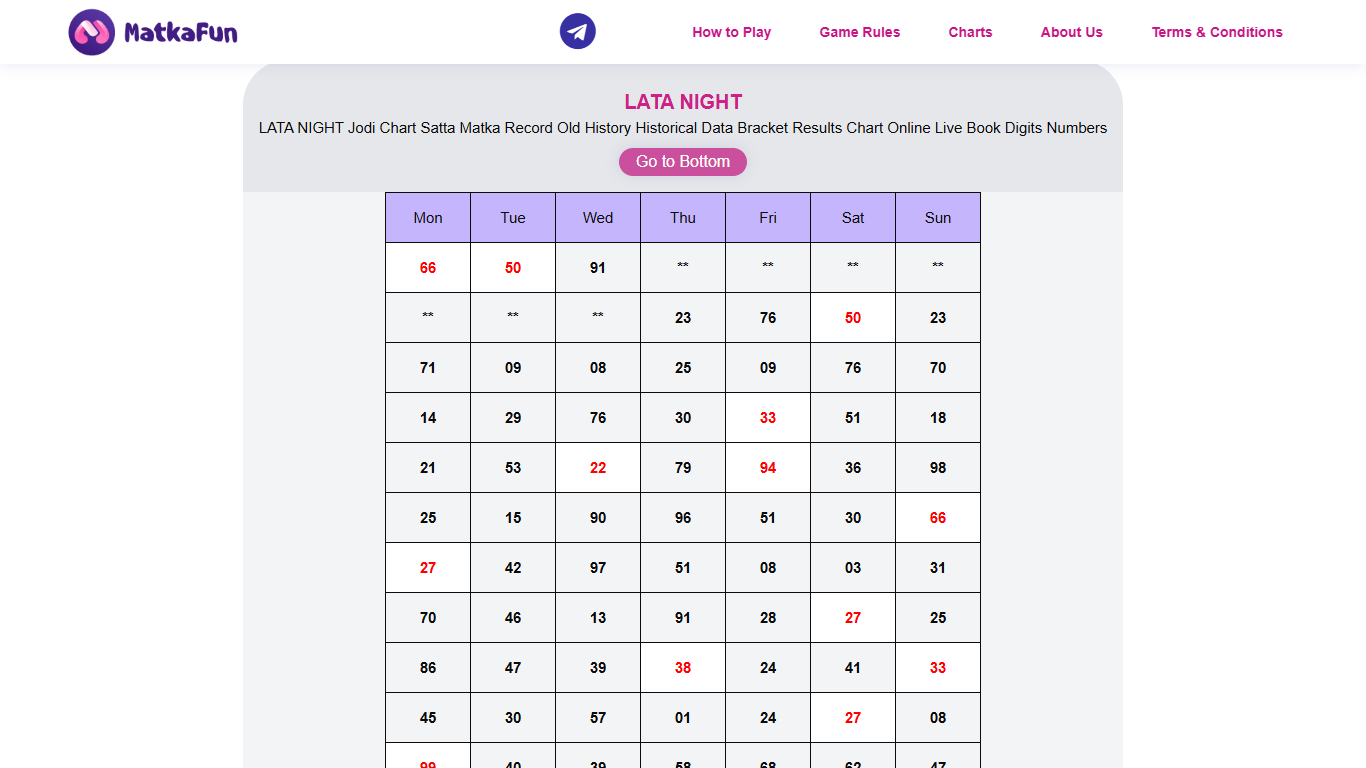
The Lata Night Chart serves as a historical record of night market results, helping users view and understand outcomes from previous days in an organized format. Over time, this chart builds a complete history that reflects how results have been recorded night after night.
This article explains what lata night chart history is, how past night results are stored, and how users can understand historical data clearly—purely for informational and educational purposes.
What Is Lata Night Chart History?
Lata Night Chart history refers to the collection of all past night results recorded in a chart format. Each entry represents an officially declared result for a specific night session.
Once a result is added:
- It becomes a permanent record
- It is not edited or replaced
- It remains part of the continuous chart sequence
This creates a long-term historical archive.
Purpose of Maintaining Chart History
The main purpose of chart history is to:
- Preserve past results
- Provide transparency
- Allow easy date-wise reference
- Maintain consistency in record keeping
Chart history helps users verify information without confusion.
How Past Night Results Are Recorded
The process of recording past results follows a consistent structure:
- Night Session Completion
The night market session concludes for the day. - Official Result Declaration
The final night result is announced. - Result Verification
The declared result is checked for accuracy. - Chart Entry
The result is entered under the correct date in the chart.
Once recorded, the entry remains unchanged.
Structure of Historical Lata Night Charts
Historical charts are usually structured as:
- Date-wise rows or columns
- Continuous night-to-night entries
- Weekly or monthly groupings
- Long-term chronological records
This structure makes it easy to track results across days, weeks, or months.
Understanding Number Formats in Past Results
Past night results may appear in standard formats such as:
- Single digit (0–9)
- Jodi (two-digit number)
- Patti / Panel (three-digit number)
These formats are used only to display results clearly and consistently.
How Users Read Past Night Results
To understand chart history:
- Start with the earliest or latest date
- Read entries in sequence
- Note the displayed number format
- Compare different dates for reference
Charts are meant to be read chronologically, not selectively.
What Chart History Can Be Used For
Lata Night Chart history can be used for:
- Reviewing past results
- Verifying previous outcomes
- Understanding how data is recorded
- Maintaining personal reference notes
It is a reference tool, not an analytical or predictive system.
What Chart History Cannot Do
Chart history cannot:
- Predict future results
- Control upcoming outcomes
- Reveal guaranteed patterns
- Provide guidance or advice
Each night’s result remains independent of previous records.
Common Misunderstandings About Chart History
Some common misconceptions include:
- Old entries may be corrected later
- Past patterns influence future results
- Chart history changes over time
In reality, historical entries remain fixed and factual.
Why Understanding Chart History Matters
Understanding chart history helps users:
- Avoid misinformation
- Read charts accurately
- Maintain realistic expectations
- Use data responsibly
Clarity reduces confusion and false assumptions.
Responsible Perspective on Chart History
Lata Night Chart history should always be viewed as:
- Informational data
- Historical records
- Transparency tools
It should not be treated as advice, prediction, or assurance.
Conclusion
The Lata Night Chart history is a reliable and organized record of past night market results. By understanding how results are recorded, structured, and preserved, users can read historical data clearly and confidently.
When approached responsibly, Lata Night Chart history serves as a valuable reference for understanding past outcomes—nothing more and nothing less.